
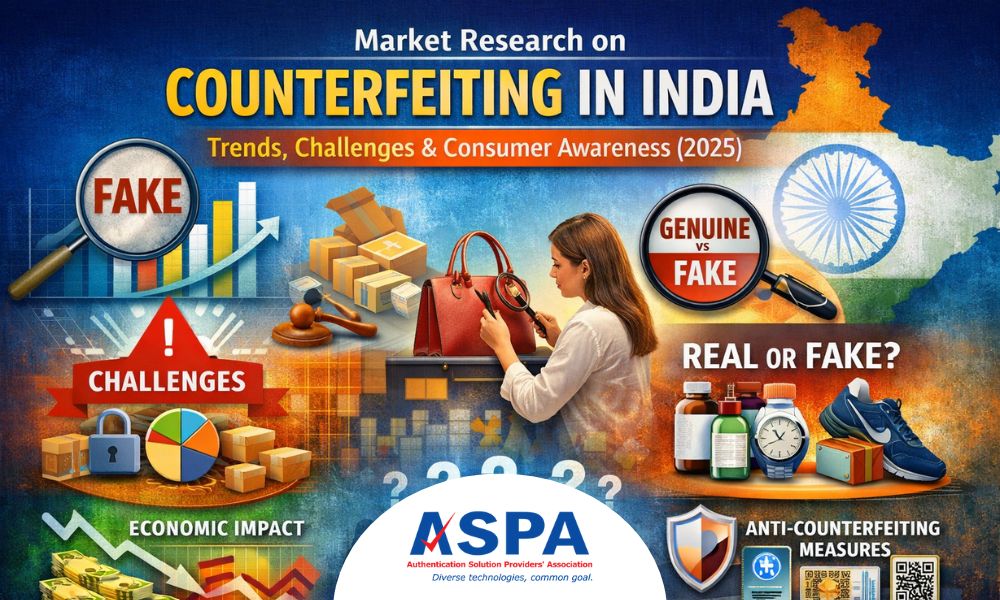
Counterfeiting has emerged as a major economic and social challenge in India. With rapid digital adoption and a booming consumer market, fake and substandard products have proliferated across industries — posing threats to public safety, brand equity, and the formal economy. This in-depth Market Research on Counterfeiting in India explores how large the problem has become in 2025, which sectors are most vulnerable, how aware consumers are, and the role of e-commerce in magnifying the issue. We also discuss how organizations like ASPA Global are contributing to anti-counterfeiting efforts.
How Big Is the Counterfeit Market in India in 2025?
The counterfeit market in India has grown significantly over the past decade. In 2025, estimates suggest the total value of counterfeit goods — from fake luxury items and electronics to spurious medicines — runs into tens of billions of dollars annually.
Key Facts (2025 Estimates)
- Counterfeit goods account for roughly 10–15% of the total retail market in certain urban centers.
- India ranks among the top countries globally for counterfeit supply and demand, especially in fashion, pharmaceuticals, cosmetics, and consumer electronics.
- Losses to legitimate businesses — from reduced sales, damaged reputation, and enforcement costs — are calculated in billions of USD every year.
Why so large?
- A fast-growing population with rising disposable income.
- High volumes of imports and unorganized production hubs in many regions.
- Limited enforcement in tier-2 and tier-3 cities.
- Expansion of online marketplaces without strong anti-fraud measures.
Overall, counterfeiting is not a niche problem anymore — it is a systemic challenge affecting multiple sectors in the Indian economy.
Which Industries in India Are Most Vulnerable to Counterfeiting?
Counterfeiting affects many industries, but a few sectors are especially exposed due to high demand and ease of replication.
Top Vulnerable Industries
- Pharmaceuticals & Health Products
- Fake medicines remain one of India’s most dangerous counterfeit categories.
- Substandard drugs lead to health hazards and fatalities.
- Fake medicines remain one of India’s most dangerous counterfeit categories.
- Fashion & Luxury Goods
- Apparel, watches, bags, and accessories are commonly replicated.
- Counterfeits are sold online and in street markets.
- Apparel, watches, bags, and accessories are commonly replicated.
- Consumer Electronics
- Chargers, headphones, memory cards, and even smartphones are frequently faked.
- Inferior performance and safety risks are common.
- Chargers, headphones, memory cards, and even smartphones are frequently faked.
- Automobile Parts
- Counterfeit spark plugs, brake pads, and filters pose safety issues.
- Counterfeit spark plugs, brake pads, and filters pose safety issues.
- Food & Beverages
- Imitation food products and adulterated consumables threaten public health.
- Imitation food products and adulterated consumables threaten public health.
- Cosmetics & Personal Care
- Eye shadows, creams, perfumes, and skincare products often contain harmful chemicals.
- Eye shadows, creams, perfumes, and skincare products often contain harmful chemicals.
These industries remain vulnerable due to:
- Strong consumer demand for cheaper alternatives.
- Difficulty in quality verification at the point of sale.
- Complex supply chains that leave gaps for fake products to enter.
How Aware Are Indian Consumers About Counterfeit Products?
Consumer awareness is improving, but gaps remain — particularly outside major cities.
Awareness Levels (General Trends)
Urban Consumers
- More likely to recognize brand authenticity features.
- Increasingly cautious about purchasing from unverified sources.
- Often check labels, holograms, QR codes, and packaging.
Rural Consumers
- Lower awareness due to limited brand exposure.
- Price often outweighs authenticity concerns.
- Fake products are sometimes normalized in local markets.
Consumer Concerns
- Safety: Especially for pharmaceuticals and baby products.
- Durability: Electronics and auto parts fail sooner.
- Brand Trust: Counterfeits damage consumer confidence.
Despite these concerns:
- Around 30–40% of buyers admit they have purchased counterfeit goods knowingly due to low prices.
- Many consumers still struggle to distinguish real from fake without expert help.
This gap in awareness underlines the importance of education campaigns, stronger enforcement, and tools that help consumers authenticate products instantly.
How Has E-Commerce Accelerated Counterfeiting in India?
E-commerce platforms have dramatically transformed retail in India — but they have also inadvertently become conduits for counterfeit products.
Ways E-Commerce Has Fueled Counterfeiting
- Ease of Seller Registration
- Sellers can list products with minimal verification.
- Fake or non-compliant vendors get access quickly.
- Sellers can list products with minimal verification.
- High Volume + Low Oversight
- Millions of products are listed every day.
- Monitoring each item manually is impractical.
- Millions of products are listed every day.
- Third-Party Fulfillment
- Counterfeit goods get sold alongside genuine items.
- Consumers struggle to differentiate based on listings alone.
- Counterfeit goods get sold alongside genuine items.
- Price Competition
- Extremely low prices raise red flags but attract buyers.
- Discount-driven behaviour encourages demand for cheap fakes.
- Extremely low prices raise red flags but attract buyers.
Examples
- Fake cosmetics masquerading as branded items.
- Imitation smartphone accessories sold through third-party sellers.
- Counterfeited toys marketed to children.
Many large platforms have responded with anti-counterfeit policies, but enforcement remains uneven. Stronger AI-driven detection systems, seller vetting, and customer education are crucial next steps.
Role of ASPA Global in Tackling Counterfeiting
Organizations like ASPA Global are stepping up to fight the counterfeit crisis in India.
What ASPA Global Does
- Brand Protection Services
ASPA Global helps companies detect fake products online and offline, using advanced monitoring technologies. - Consumer Awareness Campaigns
Through outreach initiatives, the organization educates buyers on how to spot counterfeit goods and why authenticity matters. - Collaboration with Law Enforcement
ASPA Global works with government agencies and investigative teams to identify major perpetrators and support enforcement actions. - Data & Analytics
The organization compiles market data on counterfeit trends — helping brands make informed decisions.
By facilitating communication between brands, consumers, and authorities, ASPA Global plays a meaningful role in minimizing the spread of counterfeits and protecting India’s market integrity.
Key Challenges in Combating Counterfeiting in India
Despite progress, several obstacles remain:
Enforcement Gaps
- Slow judicial processes for intellectual property (IP) cases.
- Limited manpower for raids and inspections.
Consumer Behaviour
- High price sensitivity increases demand for cheap alternatives.
- Some consumers don’t perceive counterfeits as harmful.
Complex Supply Chains
- Unregulated distributors make oversight difficult.
- Fake products move across state lines with ease.
E-Commerce Limitations
- Platforms struggle to remove illegal listings fast enough.
- AI tools are improving but not foolproof.
Addressing these challenges requires collaboration among brands, marketplaces, regulators, and consumer groups.
Conclusion: A Roadmap for the Future
The counterfeiting problem in India in 2025 is significant, cutting across industries and demographics. However, increased consumer awareness, stronger legal enforcement, and proactive measures by organizations such as ASPA Global offer hope for meaningful progress.
Steps Forward
Consumer education campaigns
Real-time authentication tools
Robust seller vetting on e-commerce platforms
Stricter penalties for counterfeiters
Industry collaboration and data sharing
Summary in Points
- Counterfeiting in India is a multi-billion dollar challenge in 2025.
- Top affected sectors include pharmaceuticals, fashion, electronics, auto parts, and cosmetics.
- Consumer awareness is rising but still uneven across regions.
- E-commerce has accelerated the spread of fake products due to scale and minimal seller checks.
- ASPA Global plays a crucial role in anti-counterfeiting efforts.
- Joint actions by brands, regulators, and citizens are key to reducing counterfeit markets.
 marketresearchoncounterfeitinginindia.fashion.blog
Leave a comment